Science is Real
Saturday, July 4th, 2020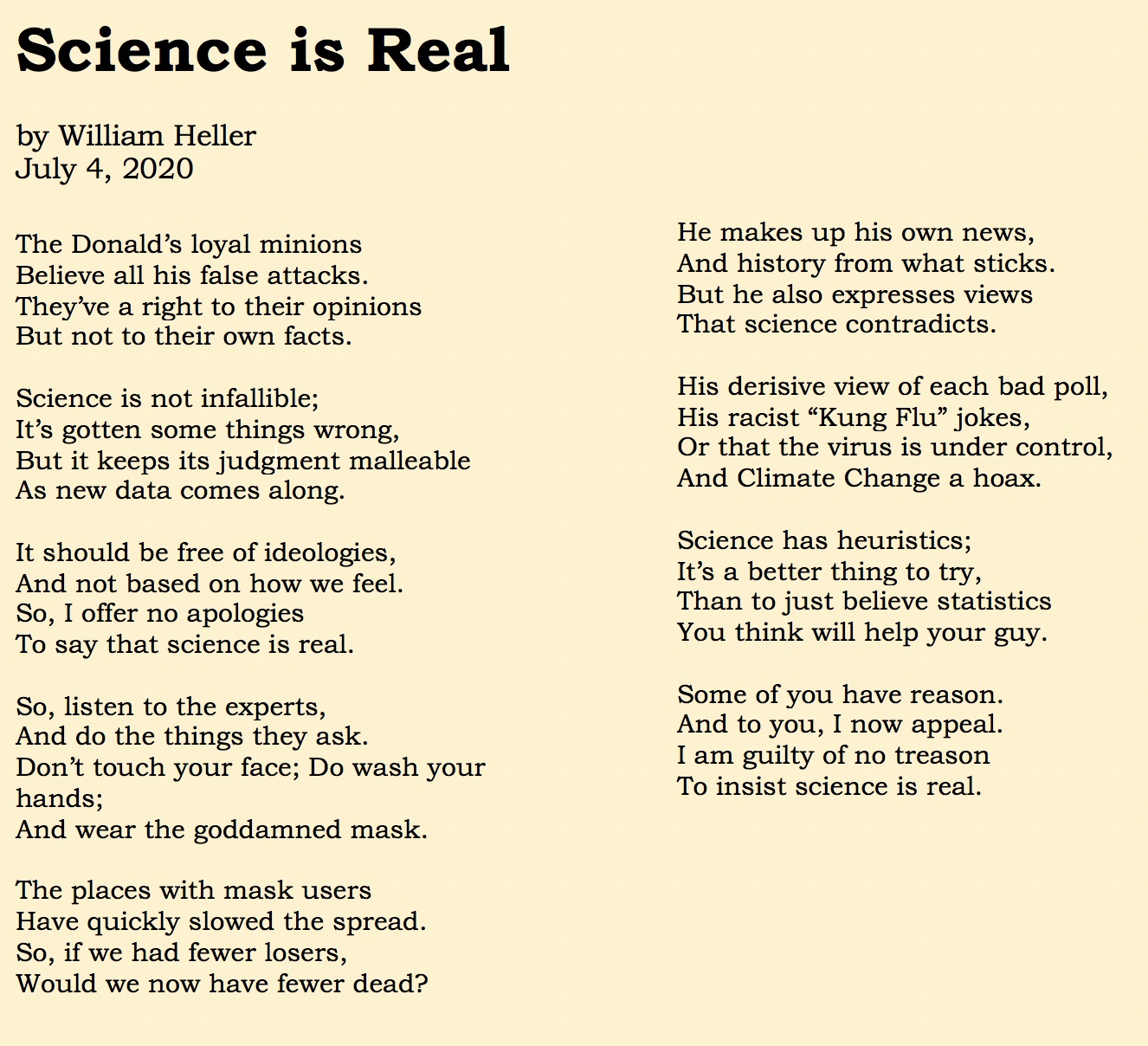
Donald Trump now stands the third impeached president in the history of the United States.
This is not a time for celebration. I supported impeachment because I believed the president’s abuse of power was incompatible with faithful leadership, and for the House to do any less would be a dereliction of duty. But the fact that we as a nation have fallen to the point where we have a president who required impeachment is a disgrace against all of us.
The president’s party continues to vehemently defend him, though there are exceptions. Four prominent Republican pundits published an anti-Trump op-ed in The New York Times. Christianity Today supports removal. Even The National Review has turned on him. But the majority of public-facing Republicans are still in his corner. Mitch McConnell is planning to blow off the trial, while Lindsey Graham won’t even pretend he’s going to be an impartial juror.
When I hear someone defending the president, I want to ask them if they believe the president didn’t do the things he’s accused of, or he did them but was perfectly entitled to do so. Trump was impeached on two very specific charges. He abused the power of his office to pressure Ukraine to announce an embarrassing investigation of his political opponent. He issued a blanket denial of congressional subpoenas for himself, his government branch, and all documents being requested as part of Congressional oversight. So did he not do these things? Are they okay to do? I’m not really sure what the defense is supposed to be here.
Impeachment is a big deal, if for no other reason but that it indelibly records the president’s misdeeds in the history books. But I hope history will also remember the craven Republicans who stood by him when their country needed them to have some integrity and take a stand. Some are saying that Nancy Pelosi should deny sending the articles of impeachment to the Senate. But I’d like to see them take a vote. Let each and every one of them decide what they want the first line of their obituary to be.
From Richard II:
I am disgraced, impeach’d and baffled here
Shift around the letters, and it becomes:
An addled chamber hid a spied crime gaffe.
It’s hard to meet people these days. You may have even seen some online lists of pick-up lines, quick conversation starters for approaching women in bars.
But what if the object of your affection is a Shakespeare fan? Below you will find a list of sure-fire Shakespeare-themed pick-up lines that are guaranteed to breed love’s settled passions in her heart.
Note: This is a parody. Always treat others with respect, and never actually use any of these rude pick-up lines on a real woman in a bar*.
Good luck, and have fun!
—
*I have actually used all of these lines on a real woman in a bar.


It’s been a rough week for us liberals, and there’s a lot going on in the county right now. But for today’s anagram, I want to focus in on just one thing that I think deserves more attention than it has been getting. We’ve all heard about the children in cages, but I want to focus on the process that makes it possible to put children in cages without losing your political supporters or facing consequences of any kind.
Last Friday, the Republican president held a press event featuring families of the victims of crimes committed by undocumented immigrants. He calls them “Angel Families,” which is a term coined by him to describe this very specific and highly selected group of people.
Now, I was brought up Jewish, and in my religious education, we learned how scapegoating was used to turn European populations against the Jewish people during the Diaspora, most notably in Nazi Germany. This was something we were always taught to be on the lookout for, but I honestly never thought I’d see it to this degree in America during my own lifetime.
Trump’s display last Friday was not only disgusting, but frighteningly dangerous. I certainly empathize with the genuine grief of the families, but parading them up on stage to exploit that grief for cynical propaganda is an abomination. You could cherry-pick victims of any group and put their families on the dais. What if the families were selected because they had lost their loved ones at the hands of black people? Or Christian fundamentalists? Police officers? How about families of people who were killed at Walt Disney World?
Imagine how you might be made to feel if the president gathered up the families of all of the people who died in vending machine accidents. (It’s a thing; the stuff doesn’t come out, they shake the machine, and it falls on them.) Family member after family member gets up to share how their lives have been torn apart by loved ones lost to vending machines. Given enough time, you might come to feel that vending machines are an existential menace, one that must be immediately addressed with urgency and ruthlessness. Using this technique to vilify an entire class of people should earn you a special place in hell.
The matter has been well researched. Immigrants (both documented and undocumented) commit crimes at a lower rate than the native born. As Paul Krugman points out, this is not a poor solution to a pressing issue; it’s an entirely manufactured issue:
What’s almost equally remarkable about this plunge into barbarism is that it’s not a response to any actual problem. The mass influx of murderers and rapists that Trump talks about, the wave of crime committed by immigrants here (and, in his mind, refugees in Germany), are things that simply aren’t happening. They’re just sick fantasies being used to justify real atrocities.
This is where checks and balances are supposed to kick in, but the Republicans control both houses of Congress, and are currently abrogating that responsibility. We can all agree that stoking hatred toward minorities is not what America is supposed to be about, but we should also remember that it is not even what the Republican party is supposed to be about. Take a look at the 1980 Republican primary debate between Ronald Reagan and George H.W. Bush. The two future Republican presidents are asked about illegal immigration and both respond with empathy and compassion.
On the other side, the party’s base really does love Trump, not for his policies, but for the performative cruelty he exhibits toward racial minorities and the way he sticks his thumb in the eyes of “elites.” So any Republican politician who takes a stand on behalf of what we used to think were fundamental American values is at high risk of losing his or her next primary. And as far as we can tell, there is not a single elected Republican willing to take that risk, no matter what Trump does.
We knew what Trump was when he was elected. But to be honest, I thought there would be more Republicans of conscience to keep him in check. Once this is all over, and it will end eventually, I think it will be a long time before the Republican party will be able to regain its credibility.
And I know this moral outrage is hardly unique to my own personal sensibilities. Many, many people are saying the exact same things. But it was important to me that I be one of them. And now that I have, let’s get back to the real business of this website and do a Shakespeare anagram.
Today’s selection is from a well-circulated passage that Shakespeare wrote for Sir Thomas More. I’m only going to anagram the end because the shorter anagrams are harder and therefore (in my mind) more impressive. But I’m also including a video of the speech in its entirety, because it speaks to the present moment as well as anything does, and once again, Shakespeare reminds us of what it means to be human.
This is the strangers’ case;
And this your mountanish inhumanity.
Shift around the letters, and it becomes:
This insanity!
Time in cages? To shun norms? Deny truth?
Ah ha! Russia.
From The Taming of the Shrew:
And awful rule and right supremacy
Shift around the letters, and it becomes:
Uh… Trump defends an ugly racial war?
Here is the video of Tuesday’s press conference. I recommend you watch the whole thing, if you haven’t already. Future generations will be watching this in their social studies classrooms.
In Macbeth, King Duncan receives a report on the execution of the Thane of Cawdor, who had betrayed him in the war against Norway. Duncan notes his own surprise at the deception:
There’s no art
To find the mind’s construction in the face:
He was a gentleman on whom I built
An absolute trust.
No art to find the mind’s construction in the face? Is it really possible that nobody in Shakespeare’s time (or even Macbeth’s time) had thought to study this? And if not, where is Shakespeare getting the idea from? My Arden Macbeth (Sandra Clark and Pamela Mason, eds.) says that it is proverbial, but that only raises more questions about what is meant by it. In all honesty, I think it’s time to bring back the Shakespeare Follow-Up.
First of all, the idea that different emotions would register in an observable way has always been as plain as the smile on your face. If anyone wants to doubt that, they need only look at the types of masks used in ancient Greek theatre to represent comedy and tragedy and see if they can tell which is which.

So the idea of finding the mind’s construction in the face was well known in Macbeth’s time. But what about someone who intends to deceive? How could Duncan have uncovered Cawdor’s treachery?
As long as there have been liars, there have been techniques attempting to reveal them, which have had various degrees of accuracy. In ancient China, they used to put dried rice in a suspect’s mouth and ask them to spit it out. If they were lying, their mouths would be too dry to spit out the rice. At least, that’s what they said on The Unit (see 5:30 to 7:10 below):
In the clip, Jonas mentions the witch trials, and indeed, the trial by ordeal was a common method of uncovering deceivers throughout medieval Europe, whether by water, combat, fire, or hot iron. As Europe approached the Renaissance, these beliefs began to slowly evolve, marking a significant gap between the worldviews of Macbeth’s time and Shakespeare’s.
Shakespeare himself seemed intrigued with the idea that one could alter one’s own face to conceal evil intentions. Hamlet has an epiphany that “one may smile, and smile, and be a villain.” And in Henry VI, Part Three, the future King Richard III actually brags about being such a villain:
Why, I can smile, and murder whiles I smile,
And cry ‘Content’ to that which grieves my heart,
And wet my cheeks with artificial tears,
And frame my face to all occasions.
Could Shakespeare have been influenced by the writings of French philosopher Michel de Montaigne? In his late 16th-century essay Of Physiognomy, Montaigne muses on this very question, ascribing moral implications to a false aspect:
The face is a weak guarantee; yet it deserves some consideration. And if I had to whip the wicked, I would do so more severely to those who belied and betrayed the promises that nature had implanted on their brows; I would punish malice more harshly when it was hidden under a kindly appearance. It seems as if some faces are lucky, others unlucky. And I think there is some art to distinguishing the kindly faces from the simple, the severe from the rough, the malicious from the gloomy, the disdainful from the melancholy, and other such adjacent qualities. There are beauties not only proud but bitter; others are sweet, and even beyond that, insipid. As for prognosticating future events from them, those are matters that I leave undecided.
Sorry, Duncan.
The 18th-century actor David Garrick turned this vice into a virtue, developing great fame for his repertoire of facial expressions that could be used to convey a wide range of emotions on stage. Charles Darwin, in his 1872 work The Expression of the Emotions in Man and Animals, identified a specific set of facial expressions that he believed to be universal to humans as a product of evolution. Today, we know that, while many facial expressions are generally universal, they can be profoundly influenced by culture.
In the 20th century, the rise of the polygraph machine added an extra level of science to lie detection. The machine registers physiological responses the subject exhibits while answering questions. It’s not infallible, and it’s not unbeatable, but it just might have been able to reveal the Thane of Cawdor’s treachery, had it been available to apply.
But as far as finding the mind’s construction in the face, we should turn to the poker community, which has made a small science of identifying expressions, statements, and actions that reveal the strength or weakness of a players hand. When there’s money on the table, every advantage matters. These “tells” are catalogued, studied, observed, and – of course – faked when the opportunity arises. Some poker players, to defend against being read in this way, will conceal their faces with visors, hoodies, or even sunglasses. Interestingly enough, sunglasses were first invented in 12th century China, where they were originally worn by judges to assist them in concealing their emotions during a trial.
But the master of the art of finding the mind’s construction in the face would have to be Dr. Paul Ekman. Ekman is mostly famous for discovering the “micro expression,” a facial tell that sweeps across the face for a fraction of a second, betraying the subject’s true emotional state. They cannot be hidden. They cannot be faked. They also cannot be read without deep training, which Ekman provides.
Ekman and his research became the inspiration for the Fox crime drama Lie to me*. On the show, Tim Roth plays Dr. Cal Lightman, a fictionalized version of Ekman. Each episode shows Lightman and his team using micro expressions and other scientific tells to find out the truth for desperate clients. If you’ve read this essay this far, you might enjoy the show:
So, with all of these clues available, how well does Duncan learn from his experience with the traitorous Thane of Cawdor? He grants the now-available title to Macbeth, and then Macbeth kills him. If there was an art to find the mind’s construction in the face, Duncan was very, very bad at it.
A Republican lawmaker has introduced a bill into the Arkansas State Legislature to ban the works of Howard Zinn in school curricula and course materials. This is just the latest of a long string of incidents of conservatives trying to change how history is taught, sometimes successfully. In order to evaluate the potential impact of such efforts, we should take a moment to consider what we believe is the purpose of our emerging citizens studying history in school. Is it to teach them how to critically evaluate historical events so they can use that knowledge to interpret current events and build a better world? Or is to infuse them with a love of their country and a proud understanding of American exceptionalism? Both of those choices sound pretty good to me, but as they are often in conflict with one another, it is incumbent on us to choose only one of them as a touchstone for making decisions about curricula and instruction. And here we find the fundamental disagreement between the left and the right when it comes to teaching history.
Conservatives pride themselves as being free thinkers, but if you examine their ideology, you’ll find that a great deal of it is based in a slavish deference to authority. The Bible says homosexuality is wrong. The framers wanted us to have unlimited access to guns. A cop shot a kid? The kid must have been asking for it. Always trust the invisible hand of the free market. Jesus, Take the Wheel. And so on. For the past eight years, this suspension of free will to the sovereign did not extend to our Democratic president, but in the past few months, conservatives have rediscovered their obedience to the chief executive. Under this ideology, we don’t want citizens to question the authority of the state; we just want them to love Big Brother. Lest you think I’m exaggerating out of some kind of misguided partisan zeal, I present this 2014 clip from Fox News about this same social studies debate, followed by a commentary by Gretchen Carlson where she clearly articulates this mindset:
If, as Phil Graham suggested, the news is the first draft of history, then Fox News is the first draft of Republican history. Carlson’s approach to teaching social studies mirrors pretty accurately the network’s approach to journalism. Facts take a backseat to spin, and point of view reigns supreme over truth. Check out this clip, also from 2014, about a then-new report on torture. Nobody in this clip denies the truth of the report; they just don’t think we should be talking about it. Andrea Tantaros is particularly bothered by the fact that the report highlights “how we’re not awesome.” Really:
The Republican sense of entitlement to create the news, as well as history, is nothing new. In a 2004 New York Times Magazine article, “Faith, Certainty, and the Presidency of George W. Bush,” Ron Suskind quotes an unnamed senior advisor to President Bush, now widely believed to be Karl Rove:
The aide said that guys like me were “in what we call the reality-based community,” which he defined as people who “believe that solutions emerge from your judicious study of discernible reality.” I nodded and murmured something about enlightenment principles and empiricism. He cut me off. “That’s not the way the world really works anymore,” he continued. “We’re an empire now, and when we act, we create our own reality. And while you’re studying that reality — judiciously, as you will — we’ll act again, creating other new realities, which you can study too, and that’s how things will sort out. We’re history’s actors . . . and you, all of you, will be left to just study what we do.”
Remember how Republicans screamed about President Obama giving a back-to-school address to children? Yet, when they’re in power, they have no problem asserting the right to define reality like the most oppressive regimes around the world. President Trump started doing this right out of the gate. He reserves the right to tweet out some absurd nonsense – like the idea that millions of illegal voters came out to vote for Hillary Clinton, thus denying him the popular vote – and to demand that it be taken as unquestionable fact. Take a look at Sean Spicer’s first stint as White House Press Secretary, clearly sent out by the boss to insist that the inauguration attendance numbers were not what they were:
This explains why Republicans have such a terrible relationship with science. Science is all about asking questions and overthrowing the establishment when the facts justify it. We don’t believe in evolution and global climate change because they support our political interests; we believe in them because of the overwhelming evidence in their favor. The Republican power structure wants to dictate what’s true and what’s not. But science doesn’t work that way, and neither does history… unless we allow them to.
That’s why it’s so important to speak out now about the changes they want to make to the way history is taught in Arkansas, and around the country. Zinn would have been the first to admit that history has a point of view, and his history in particular. But nobody is questioning the validity of Zinn’s research, only the perspective he chooses to take. It doesn’t fit in with the conservative view of patriotism, which is an unwavering insistence on American superiority and infallibility. But I would argue that Zinn’s writings are very patriotic; he just chooses to celebrate a different aspect of American history. He highlights how groups of people have come together throughout history to resist the power structure and effect change. No wonder they want him banned.
It’s important for students to have exposure to the truths of American history, even the unpleasant ones. You can’t understand the facts about society today without an understanding of how we got here. You can’t have an opinion about Standing Rock without knowing about the genocide of the Native Americans and their subsequently troubled history. You can’t intelligently discuss Black Lives Matter without an understanding of slavery and the civil rights movement. You can’t truly contextualize the treatment of Muslims in America post-9/11 without an understanding of how the Japanese internment camps came about and were later judged. The most unpleasant moments of history turn out to be our most teachable moments. We can still love America, warts and all, by celebrating, as Zinn does, our potential for growth and change. What a low opinion of America it must take to believe that students won’t love it if they have all of the information. So when administration officials, such as Ben Carson or Betsy DeVos, make statements that demonstrate a shocking misunderstanding of American history, it may be less about their ignorance and more about their arrogance. But Anderson Cooper demonstrates the dangers of allowing conservatives to just make up the version of history they want to present:
I do realize that I’m taking a very partisan tone in an essay that’s supposed to be about how to best teach history. But I really do see this as a partisan battle, and even more so now that we have a president who not only creates his own reality space, but seems to be taking about a third of the country along with him. Teaching critical thinking in social studies has never been more important. Ignorance breeds hate, and hate is a powerful weapon in dividing us. One side is trying to start a dialogue; the other side is trying to shut it down. We have to teach students how to question authority, how to find credible information about the issues, and how to make their voices heard in a way that matters. This does not mean liberal indoctrination. I’m perfectly happy to support my students in researching and debating the conservative side of the issues. Reasonable people can disagree, and classroom debates should mirror the real discussions happening across the country. But if your opinions aren’t informed by historical perspective and you only react based on your emotions and prejudices, then I’m not really all that interested in debating you.
Without a clear understanding of the past, you cannot fully comprehend the present or work to build a better future.
In this October 2016 TED talk, Shakespearean actor and educator Rob Crisell makes a passionate argument for Shakespeare, for teaching Shakespeare, and for teaching Shakespeare through performance. Whether you’re already with him on these three points or not, it’s well worth checking out: