Shakespeare Anagram: The Comedy of Errors
Saturday, November 16th, 2019From The Comedy of Errors:
Why, what an intricate impeach is this!
Shift around the letters, and it becomes:
I hear a chatty witness.
With him? Panic.
From The Comedy of Errors:
Why, what an intricate impeach is this!
Shift around the letters, and it becomes:
I hear a chatty witness.
With him? Panic.
From Measure for Measure:
His unjust unkindness, that in all reason should have quenched her love, hath, like an impediment in the current, made it more violent and unruly.
Shift around the letters, and it becomes:
Our junk-IQ leader raids millions meant to help a veteran charity. Huh.
End hunt. Slam-dunk evidence. Huh.
No red-state tunnel-vision men listen. Huh.
From Measure for Measure:
I love the people,
But do not like to stage me to their eyes.
Though it do well, I do not relish well
Their loud applause and aves vehement,
Nor do I think the man of safe discretion
That does affect it.
Shift around the letters, and it becomes:
Trump was booed, a lot, at the World Series venue.
He thought the likelihood of monumental attendee reception lifted after he took the noted ISIS villain.
The vocal people didn’t satisfy his ego.
This week, Ambassador William Taylor gave testimony that many are calling the smoking gun for proving Trump intended a quid pro quo deal with the Ukraine, making impeachment seem all but inevitable.
What makes this funny to me is that quid pro quo was never really the standard. Just asking the Ukrainian president to announce a baseless investigation in order to affect our elections should have been enough to start impeachment proceedings. It was President Trump who drew the line at quid pro quo by repeatedly denying it had happened at every opportunity, a strategy that has apparently worked for him with “no collusion.” What’s more, the evidence for quid pro quo was already clear in even the White House’s released transcript of the phone call with Zelensky.
Still, Ambassador Taylor’s testimony seems to have shifted the ground somewhat, and Republicans are in full meltdown mode. On Wednesday, a group of GOP congressmen stormed a closed-door meeting where Pentagon official Laura Cooper was testifying. Cooper had been warned by the Trump administration not to testify, but she did anyway, so a protest was staged to disrupt the hearing.
And I do mean staged. Some of the Republican congressmen who were part of the protest were actually members of the committees doing the inquiry, and so they had every right to attend the meetings they were protesting not being allowed to attend. All of the committees are made up of Democrats and Republicans, all of whom are allowed to cross-examine witnesses in the hearings.
What’s more, the protesters violated any number of rules, including those prohibiting electronic devices in the secure room where the inquiry was being held. Maybe they think that rules don’t apply to them any more. Perhaps that’s something they picked up from President Trump himself, who apparently knew about the stunt in advance.
If you’ve reached the point where you need to send in your gang to physically disrupt the investigation of your crimes, it just might be time to resign.
From Henry VI, Part One:
I cry you mercy, ’tis but quid for quo.
Shift around the letters, and it becomes:
Mob rids query to crucify you? Quit!
This week brought in an avalanche of impeachment evidence, and I’m no longer sure what’s supposed to be a distraction from what.
Should I be focused on the emoluments violation of him hosting the G7 conference in Doral? Or should I be keeping my eye on the fact that Trump businesses kept two sets of books so they could commit tax fraud? Is this week’s top story Mick Mulvaney’s “Get over it” press conference? Or is that just cover to keep me away from the newest Giuliani story? Or is all of it to keep our minds off of the Gordon Sondland testimony? I only have one anagram in me; it’s hard to know where to start.
Fortunately, the English teacher in me is not at all conflicted about this week’s most pressing evidence that the Republican president is not fit for office. It recently came out that President Trump sent President Erdogan of Turkey a letter so unhinged that it prompted a near-universal response of “Is This Real?” (click the letter below for a larger image):
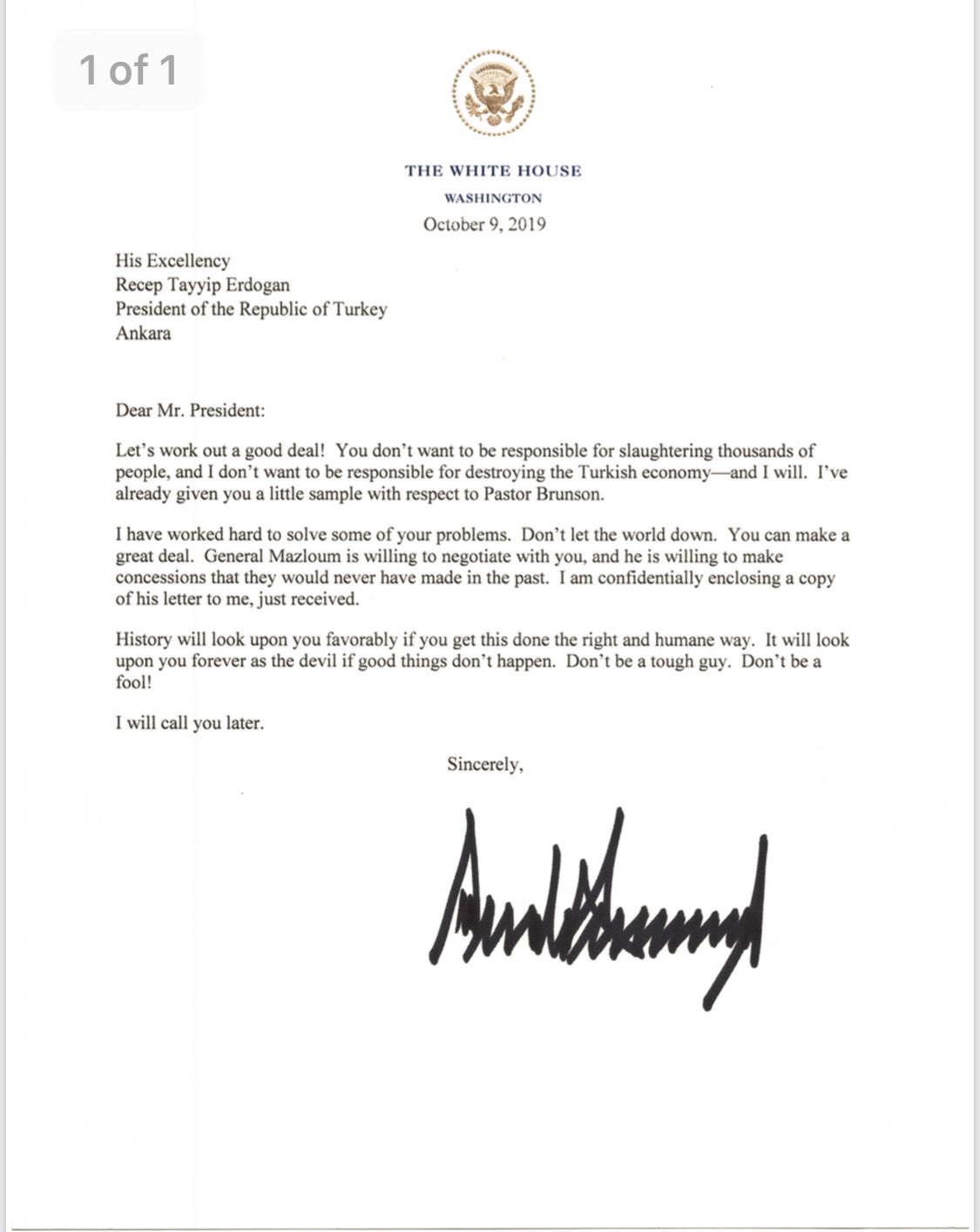
Upon receiving this letter, President Erdogan reportedly threw it in the trash.
From Hamlet:
Madness in great ones must not unwatched go.
Shift around the letters, and it becomes:
This smugness unto Erdogan came not wanted.
I’m a ’69 concert where hippies got mellow;
In Shakespeare, my murder provoked the duello;
I’m Snoopy’s small buddy, all feathered in yellow;
And also a book by that Walter Scott fellow.
Who am I?
UPDATE: Riddle solved by Asher. See comments for answer.
Now that impeachment of President Trump seems somewhat likely, some are also calling for the concurrent impeachment of Vice President Mike Pence.
Whoa, cowboy.
That’s a nice little fantasy you’ve cooked up there. I have no opinion about whether or not Pence deserves to be impeached; I’m certainly no fan, but I haven’t seen enough evidence to convince me that he should be.
But even if you disagree, there are strong arguments against bringing Pence into this. If this were a purely legal process, public opinion wouldn’t matter. But impeachment is a political process, and there needs to be a way forward after it’s over. According to a recent Fox News poll, 51 percent of American voters think that Trump should be impeached and removed from office. As the process continues, that number should continue going up. But if the Democrats are seen as making a power grab, it could go down. As long as the process ends with the Republicans retaining the Oval Office, nobody can credibly accuse them of that.
Once the House votes to impeach the president, it will be up to the Republican-controlled Senate to remove him from office, a very unlikely outcome. Until recently, I’d have said impossible, but the conservative backlash against his betrayal in Syria has been vehement. And as this president seems incapable of learning, it’s not hard to imagine him committing similar offenses in the near future. How many more of them will it take for his colleagues in the Senate to start wondering if they might not be better off dealing with a Pence administration, especially if public support for impeachment continues to grow. But there is no scenario whatsoever that would lead the Republicans in the Senate to approve a course of action that would lead to President Nancy Pelosi. None. Don’t even want it.
The main thing the Democrats have to avoid at this point is the appearance of overreach. Speaker Pelosi is well aware of this. Impeaching and removing a president is extreme enough, and it would be a phenomenal win if accomplished. But it would be a win for the American people and the principles of democracy, not the political agenda of a particular party. That’s how impeachment should be. There is a price for this kind of win, though, and that price is President Mike Pence.
I say it’s worth it.
From Julius Caesar:
Our course will seem too bloody, Caius Cassius,
To cut the head off and then hack the limbs,
Like wrath in death and envy afterwards;
Shift around the letters, and it becomes:
Many wish to handcuff the churl Donald for treason, take out the Vice Crook as well.
Eh, it’s a bad idea. House wins must stay credible.
President Trump’s decision to withdraw troops from northern Syria to make way for a Turkish invasion has met with a chorus of disapproval, including such unlikely voices as Nikki Haley, Mitch McConnell, and even Lindsey Graham. The decision was apparently made after a phone call with President Erdogan of Turkey, and seems to have caught everyone else off guard.
Clearly, a deal was made between the two leaders. But the question is, was Trump negotiating on behalf of the United States, or on behalf of Donald Trump? Given recent events involving Ukraine, it seems fair to speculate that it might be the latter. So, did Trump benefit financially from the deal, possibly related to Trump Towers Istanbul? Did Erdogan agree to dig up dirt on Trump’s political opponents? Did the orders come from Putin? We just don’t know, and again, this is all speculation. But something doesn’t feel right about this. And this time, it’s his own party that’s calling foul.
I say to them, you have only yourselves to blame. This is why we don’t tolerate corruption in our leadership. If you were comfortable with his abuse of power when it was only to steal an election, you are the ones who have given him license to abuse it now to sell out US foreign policy. For you bid this be done when evil deeds have their permissive pass and not the punishment.
From Measure for Measure:
For we bid this be done
When evil deeds have their permissive pass
And not the punishment.
Shift around the letters, and it becomes:
He’s evil. Had the dumb VIP wimps not entertained of his peevishness, he’d now be restrained.
I was planning a rant about the Ukraine scandal this morning, but the Atlantic article “If This Isn’t Impeachable, Nothing Is” says everything I was going to say and more. I can’t even pull a quote; just please go read it and then come back and enjoy the anagram.
So basically, the timeline is this:
It is now incumbent upon Congress to impeach. Failing to do so at this point is a dereliction of duty. It is no longer enough to say that we can’t do it because the Senate won’t convict. I think Representative Alexandria Ocasio-Cortez put it best (regarding calls for impeachment made before this particular scandal broke):
I want to see every Republican go on the record and knowingly vote against impeachment of this president, knowing his corruption, having it on the record so that they can have that stain on their careers for the rest of their lives, because this is outrageous to protect the amount of lawlessness and corruption coming out of this presidency.
On the other hand, if this President is still not held accountable, even for something as outrageous as this, what else will he then feel entitled to do? At some point, we have to stop blaming him for all of this, if the rest of us are willing to just sit back and allow it all to happen.
From Timon of Athens:
Nothing emboldens sin so much as mercy.
Shift around the letters, and it becomes:
Congress must hold him in, as conmen.
Bye.
It’s hard to meet people these days. You may have even seen some online lists of pick-up lines, quick conversation starters for approaching women in bars.
But what if the object of your affection is a Shakespeare fan? Below you will find a list of sure-fire Shakespeare-themed pick-up lines that are guaranteed to breed love’s settled passions in her heart.
Note: This is a parody. Always treat others with respect, and never actually use any of these rude pick-up lines on a real woman in a bar*.
Good luck, and have fun!
—
*I have actually used all of these lines on a real woman in a bar.