Grateful
Thursday, July 4th, 2019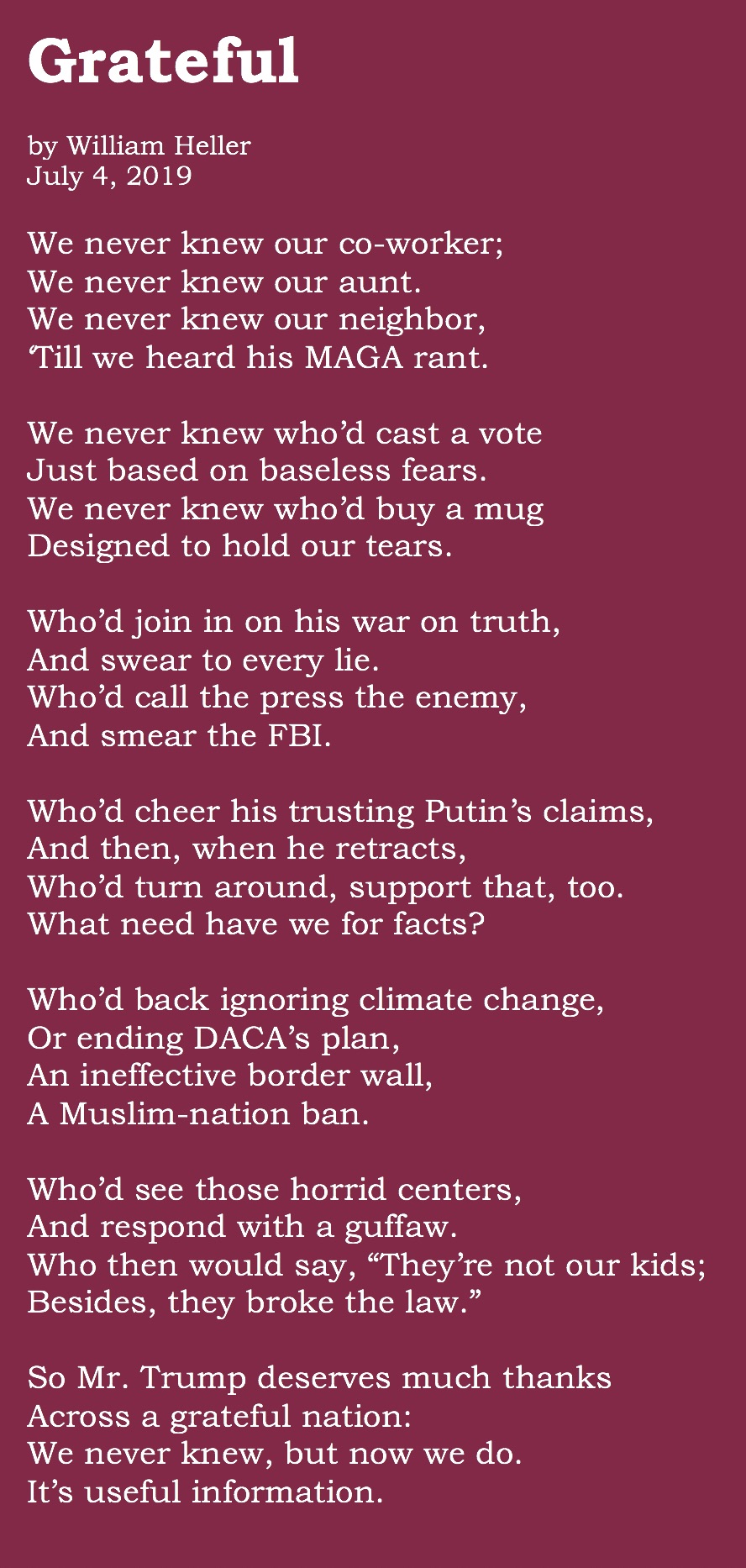
The Republican president has repeatedly referred to the press as the “enemy of the people,” a phrase most commonly associated with Stalin, but one that has a long history.
This is extremely dangerous. A free and impartial press is an essential element to our democracy. We already know that he labels any negative news about him as fake news, and counts on his blindly loyal supporters to believe him.
But calling the press the enemy of the people takes it even a step further. This is so beyond the pale, that CNN’s Jim Acosta gave Sarah Huckabee Sanders a chance to walk this back in the press briefing. She chose not to do so, and her defensive answer was filled with lies and distortions.
The last thing she said was true. She’s there to speak on behalf of the president when he makes his opinions clear, no matter how repugnant or inflammatory they may be. I imagine it’s a difficult job.
From Coriolanus:
First, you know Caius Marcius is chief enemy to the people.
Shift around the letters, and it becomes:
May I cut in, cue felicity from a White House spokesperson?
It’s been a rough week for us liberals, and there’s a lot going on in the county right now. But for today’s anagram, I want to focus in on just one thing that I think deserves more attention than it has been getting. We’ve all heard about the children in cages, but I want to focus on the process that makes it possible to put children in cages without losing your political supporters or facing consequences of any kind.
Last Friday, the Republican president held a press event featuring families of the victims of crimes committed by undocumented immigrants. He calls them “Angel Families,” which is a term coined by him to describe this very specific and highly selected group of people.
Now, I was brought up Jewish, and in my religious education, we learned how scapegoating was used to turn European populations against the Jewish people during the Diaspora, most notably in Nazi Germany. This was something we were always taught to be on the lookout for, but I honestly never thought I’d see it to this degree in America during my own lifetime.
Trump’s display last Friday was not only disgusting, but frighteningly dangerous. I certainly empathize with the genuine grief of the families, but parading them up on stage to exploit that grief for cynical propaganda is an abomination. You could cherry-pick victims of any group and put their families on the dais. What if the families were selected because they had lost their loved ones at the hands of black people? Or Christian fundamentalists? Police officers? How about families of people who were killed at Walt Disney World?
Imagine how you might be made to feel if the president gathered up the families of all of the people who died in vending machine accidents. (It’s a thing; the stuff doesn’t come out, they shake the machine, and it falls on them.) Family member after family member gets up to share how their lives have been torn apart by loved ones lost to vending machines. Given enough time, you might come to feel that vending machines are an existential menace, one that must be immediately addressed with urgency and ruthlessness. Using this technique to vilify an entire class of people should earn you a special place in hell.
The matter has been well researched. Immigrants (both documented and undocumented) commit crimes at a lower rate than the native born. As Paul Krugman points out, this is not a poor solution to a pressing issue; it’s an entirely manufactured issue:
What’s almost equally remarkable about this plunge into barbarism is that it’s not a response to any actual problem. The mass influx of murderers and rapists that Trump talks about, the wave of crime committed by immigrants here (and, in his mind, refugees in Germany), are things that simply aren’t happening. They’re just sick fantasies being used to justify real atrocities.
This is where checks and balances are supposed to kick in, but the Republicans control both houses of Congress, and are currently abrogating that responsibility. We can all agree that stoking hatred toward minorities is not what America is supposed to be about, but we should also remember that it is not even what the Republican party is supposed to be about. Take a look at the 1980 Republican primary debate between Ronald Reagan and George H.W. Bush. The two future Republican presidents are asked about illegal immigration and both respond with empathy and compassion.
On the other side, the party’s base really does love Trump, not for his policies, but for the performative cruelty he exhibits toward racial minorities and the way he sticks his thumb in the eyes of “elites.” So any Republican politician who takes a stand on behalf of what we used to think were fundamental American values is at high risk of losing his or her next primary. And as far as we can tell, there is not a single elected Republican willing to take that risk, no matter what Trump does.
We knew what Trump was when he was elected. But to be honest, I thought there would be more Republicans of conscience to keep him in check. Once this is all over, and it will end eventually, I think it will be a long time before the Republican party will be able to regain its credibility.
And I know this moral outrage is hardly unique to my own personal sensibilities. Many, many people are saying the exact same things. But it was important to me that I be one of them. And now that I have, let’s get back to the real business of this website and do a Shakespeare anagram.
Today’s selection is from a well-circulated passage that Shakespeare wrote for Sir Thomas More. I’m only going to anagram the end because the shorter anagrams are harder and therefore (in my mind) more impressive. But I’m also including a video of the speech in its entirety, because it speaks to the present moment as well as anything does, and once again, Shakespeare reminds us of what it means to be human.
This is the strangers’ case;
And this your mountanish inhumanity.
Shift around the letters, and it becomes:
This insanity!
Time in cages? To shun norms? Deny truth?
Ah ha! Russia.
Let’s call it the strange case of Dr. Jekyll and President Hyde.
It all started last weekend, when a coalition of white supremacist organizations staged a demonstration in Charlottesville, Virginia. The idea was that the different alt-right factions, including the Ku Klux Klan and the neo-Nazis, could come together and present a unified front for nationalism and racial purity. With swastika flags, burning torches, and chants such as “Jews will not replace us,” they presented an unambiguous message of anger and hate. Counter-protesters showed up to resist their message, and one particularly disturbed individual drove his car into them, injuring many, and killing Heather Heyer, age 32.
Before we go on, it should be clear that this is not in any way a left vs. right thing. This has nothing to do with Republican or Democratic ideology. Everyone in America should be against this, regardless of how you feel about the tax code or health care reform. And indeed, many prominent Republicans immediately spoke out against this protest and its message of hate. We should expect no less.
But on Saturday, as the events were still unfolding, President Trump came out to read a prepared statement, in which he stated that “we condemn in the strongest possible terms this egregious display of hatred, bigotry, and violence.” He then stopped reading, looked up, and added “on many sides… on many sides.”
Deflection is a common rhetorical technique, used by politicians and their supporters, mainly when they are losing the argument and want to shift the focus of the conversation. Push a Trump supporter (or President Trump himself) too far, and you’ll get an earful of Benghazi or Hillary’s e-mails. And, yes, we do it too when our back is against the wall. (Sure, Obama used drones, but Bush did it too!)
So there’s nothing unusual about deflection, and it’s easy to call it out when it happens. But why on earth would President Trump use such a technique, or any technique at all, to defend the white supremacists? Sure, you can use deflection to shift focus onto the counter-protesters if you want to. But why? It only makes sense if you see the alt-right as “your side.” Is that what the President was signaling?
Needless to say, many were left feeling unsatisfied with this statement on Saturday. Pushback against his comments became so ubiquitous that he was forced to issue another statement last Monday. This time, he said all of the things a President is supposed to say, decrying racism as evil, and naming the various hate groups as well as the name of the woman who died in the protest. Some said he looked like a hostage being forced to read a statement against his will. Others criticized him for not speaking out sooner. But he said everything we asked him to say, and if he had left it there, the issue would have been closed.
He did not leave it there.
The next day, he was making an announcement about infrastructure. But when he took questions, they were not about infrastructure. This time, the President, finally freed from the oppressive shackles of prepared statements written by his more thoughtful policy advisors, doubled down on his deflection away from the white supremacists. He never explicitly said both sides were equally to blame, but that seemed to be his attitude. He coined the term “alt-left” as though people who want to raise the minimum wage and implement a single-payer healthcare system were on the same moral plane as Nazis. He also implied that it was the counter-protestors who were physically attacking the alt-right, when all of the evidence I’ve seen is to the contrary. He also felt the need to point out that the white supremacists had a permit, while the counter-protesters did not. (Seriously, he said that.) This was a new low for the Trump presidency, and that’s no easy bar to clear.
But then, this past Monday, he gave an address laying out a foreboding agenda in Afghanistan. Content aside, he was calmly reading from the teleprompter, just like a real big-boy president. He was measured, dignified, and – dare I say it – uncharacteristically presidential. He began with an eloquent call for unity against division. Had he not already relinquished all moral authority to make such a statement, it would have been beautiful. And when he talked about Afghanistan, he projected strength and resolve. There was the occasional reference to the previous administration’s blame and more than a little unearned braggadocio, but he didn’t trip over the podium or light himself on fire, and I caught myself hoping to see more of this president moving forward.
It took exactly one day to burst that bubble. At a campaign rally (!) in Arizona on Tuesday, he gave a completely unhinged performance, telling an alternate-universe version of the story above, and attacking the media as fake news outlets out to get him personally.
At the moment, it feels like we have two presidents, and when he speaks, we don’t know which one we’re going to get. But let’s not be under any illusions about which one is the @realDonaldTrump.
From Twelfth Night:
One face, one voice, one habit, and two persons;
A natural perspective, that is, and is not!
Shift around the letters, and it becomes:
I see two presidents: one, a non-factual peevish scab; another can pivot, read notation.
The NRA put out a frightening new ad this week:
From Julius Caesar:
Good friends, sweet friends, let me not stir you up
To such a sudden flood of mutiny.
Shift around the letters, and it becomes:
NRA’s odd spot: you fomented furious domestic strife; the guns will not defend you!
A Republican lawmaker has introduced a bill into the Arkansas State Legislature to ban the works of Howard Zinn in school curricula and course materials. This is just the latest of a long string of incidents of conservatives trying to change how history is taught, sometimes successfully. In order to evaluate the potential impact of such efforts, we should take a moment to consider what we believe is the purpose of our emerging citizens studying history in school. Is it to teach them how to critically evaluate historical events so they can use that knowledge to interpret current events and build a better world? Or is to infuse them with a love of their country and a proud understanding of American exceptionalism? Both of those choices sound pretty good to me, but as they are often in conflict with one another, it is incumbent on us to choose only one of them as a touchstone for making decisions about curricula and instruction. And here we find the fundamental disagreement between the left and the right when it comes to teaching history.
Conservatives pride themselves as being free thinkers, but if you examine their ideology, you’ll find that a great deal of it is based in a slavish deference to authority. The Bible says homosexuality is wrong. The framers wanted us to have unlimited access to guns. A cop shot a kid? The kid must have been asking for it. Always trust the invisible hand of the free market. Jesus, Take the Wheel. And so on. For the past eight years, this suspension of free will to the sovereign did not extend to our Democratic president, but in the past few months, conservatives have rediscovered their obedience to the chief executive. Under this ideology, we don’t want citizens to question the authority of the state; we just want them to love Big Brother. Lest you think I’m exaggerating out of some kind of misguided partisan zeal, I present this 2014 clip from Fox News about this same social studies debate, followed by a commentary by Gretchen Carlson where she clearly articulates this mindset:
If, as Phil Graham suggested, the news is the first draft of history, then Fox News is the first draft of Republican history. Carlson’s approach to teaching social studies mirrors pretty accurately the network’s approach to journalism. Facts take a backseat to spin, and point of view reigns supreme over truth. Check out this clip, also from 2014, about a then-new report on torture. Nobody in this clip denies the truth of the report; they just don’t think we should be talking about it. Andrea Tantaros is particularly bothered by the fact that the report highlights “how we’re not awesome.” Really:
The Republican sense of entitlement to create the news, as well as history, is nothing new. In a 2004 New York Times Magazine article, “Faith, Certainty, and the Presidency of George W. Bush,” Ron Suskind quotes an unnamed senior advisor to President Bush, now widely believed to be Karl Rove:
The aide said that guys like me were “in what we call the reality-based community,” which he defined as people who “believe that solutions emerge from your judicious study of discernible reality.” I nodded and murmured something about enlightenment principles and empiricism. He cut me off. “That’s not the way the world really works anymore,” he continued. “We’re an empire now, and when we act, we create our own reality. And while you’re studying that reality — judiciously, as you will — we’ll act again, creating other new realities, which you can study too, and that’s how things will sort out. We’re history’s actors . . . and you, all of you, will be left to just study what we do.”
Remember how Republicans screamed about President Obama giving a back-to-school address to children? Yet, when they’re in power, they have no problem asserting the right to define reality like the most oppressive regimes around the world. President Trump started doing this right out of the gate. He reserves the right to tweet out some absurd nonsense – like the idea that millions of illegal voters came out to vote for Hillary Clinton, thus denying him the popular vote – and to demand that it be taken as unquestionable fact. Take a look at Sean Spicer’s first stint as White House Press Secretary, clearly sent out by the boss to insist that the inauguration attendance numbers were not what they were:
This explains why Republicans have such a terrible relationship with science. Science is all about asking questions and overthrowing the establishment when the facts justify it. We don’t believe in evolution and global climate change because they support our political interests; we believe in them because of the overwhelming evidence in their favor. The Republican power structure wants to dictate what’s true and what’s not. But science doesn’t work that way, and neither does history… unless we allow them to.
That’s why it’s so important to speak out now about the changes they want to make to the way history is taught in Arkansas, and around the country. Zinn would have been the first to admit that history has a point of view, and his history in particular. But nobody is questioning the validity of Zinn’s research, only the perspective he chooses to take. It doesn’t fit in with the conservative view of patriotism, which is an unwavering insistence on American superiority and infallibility. But I would argue that Zinn’s writings are very patriotic; he just chooses to celebrate a different aspect of American history. He highlights how groups of people have come together throughout history to resist the power structure and effect change. No wonder they want him banned.
It’s important for students to have exposure to the truths of American history, even the unpleasant ones. You can’t understand the facts about society today without an understanding of how we got here. You can’t have an opinion about Standing Rock without knowing about the genocide of the Native Americans and their subsequently troubled history. You can’t intelligently discuss Black Lives Matter without an understanding of slavery and the civil rights movement. You can’t truly contextualize the treatment of Muslims in America post-9/11 without an understanding of how the Japanese internment camps came about and were later judged. The most unpleasant moments of history turn out to be our most teachable moments. We can still love America, warts and all, by celebrating, as Zinn does, our potential for growth and change. What a low opinion of America it must take to believe that students won’t love it if they have all of the information. So when administration officials, such as Ben Carson or Betsy DeVos, make statements that demonstrate a shocking misunderstanding of American history, it may be less about their ignorance and more about their arrogance. But Anderson Cooper demonstrates the dangers of allowing conservatives to just make up the version of history they want to present:
I do realize that I’m taking a very partisan tone in an essay that’s supposed to be about how to best teach history. But I really do see this as a partisan battle, and even more so now that we have a president who not only creates his own reality space, but seems to be taking about a third of the country along with him. Teaching critical thinking in social studies has never been more important. Ignorance breeds hate, and hate is a powerful weapon in dividing us. One side is trying to start a dialogue; the other side is trying to shut it down. We have to teach students how to question authority, how to find credible information about the issues, and how to make their voices heard in a way that matters. This does not mean liberal indoctrination. I’m perfectly happy to support my students in researching and debating the conservative side of the issues. Reasonable people can disagree, and classroom debates should mirror the real discussions happening across the country. But if your opinions aren’t informed by historical perspective and you only react based on your emotions and prejudices, then I’m not really all that interested in debating you.
Without a clear understanding of the past, you cannot fully comprehend the present or work to build a better future.
The Trump White House blocked several news outlets from attending a press briefing yesterday. The banned outlets included CNN and The New York Times. Notably, reporters from Time and AP, who were invited to attend, declined to do so.
This is the kind of move dictators use to secure their power. But if you’re not a dictator, it’s the kind of move that can backfire on you fiercely.
From Richard II:
O! if you rear this house against this house,
It will the woefullest division prove
That ever fell upon this cursed earth.
Prevent it, resist it, let it not be so,
Lest child, child’s children, cry against you ‘woe!’
Shift around the letters, and it becomes:
The little negotiator-in-chief’s cruel lie did deride this TV outlet here, but has lost his only value with the press: access. Now, they can vividly report up on his Russia ties, without fear of losing it.
Loser!
From A Midsummer Night’s Dream:
The dove pursues the griffin; the mild hind
Makes speed to catch the tiger: bootless speed,
When cowardice pursues and valour flies.
Shift around the letters, and it becomes:
Paid fops chid Warren, cut off to divulge the King letter.
Nevertheless, she persisted.
Ah, she has now succeeded to a sublimer podium.
Civic protest can take many forms. Some choose to march. Others write letters and call their representatives. A few even organize members of their community to ignite collective activism.
But as far as I know, I’m the only one anagramming passages from Shakespeare into snide political commentary and posting it to the Internet.
And so, the struggle continues…
From Richard II:
Or if it be, ’tis with false sorrow’s eye,
Which for things true weeps things imaginary.
Shift around the letters, and it becomes:
I press your ire: Shifty thief tries to win a show fight with “Bowling Green Massacre.”
In which I defend the honor of the Queen…
The DNA reports are in, and the skeleton they found in that Leicester parking lot is now confirmed to be that of King Richard III. Analysis also shows he had blonde hair and blue eyes.
Somewhat overshadowing the exciting news is a discovery that came from the research team’s comparing the old king’s DNA to that of his present-day relatives. It turns out that there is a break somewhere in the male-line continuity of the Y-chromosome, the collection of genes that are only passed from father to son, suggesting a false paternity event somewhere in the timeline.
The news media, with its trademark restraint, has jumped all over this, trumpeting that the already much-maligned Richard has infidelity in his family tree, with some even suggesting that this means that the Queen may not even be the legitimate heir to the throne anymore.
Okay, let’s all take a breath now. Her Majesty’s reign is in no danger here.
I spent a lot of time this past summer with my nose buried in the Plantagenet family tree, and may be able to add a modicum of perspective.
You can read the science team’s original report here, but a brief summary should suffice. Richard III and his distant cousin Henry Somerset, Duke of Beaufort are both direct male-line descendants of King Edward III. The Duke has five male-line descendants alive today who agreed to participate in the study, and four of them share the same Y-chromosome, presumably inherited from Beaufort. The one who doesn’t suggests a false paternity event (or “cuckolding” in the parlance) at some point along the way, but that’s not the infidelity that made the headlines. Richard III’s Y-chromosome also doesn’t match the Duke’s, which means that at least one of them is not actually a male-line descendant of Edward III.
Okay, so that’s pretty saucy news in itself. But it’s an overreach to drag Queen Elizabeth II into this story for several reasons.
First of all, what is the probability that the break in paternity is even in Elizabeth’s line? Here is the family tree for the relevant players (scroll down to the “Geneology of the Y chromosome lineage” graphic). It shows fifteen paternal links between Edward III and Beaufort, and only four between Edward III and Richard III. Assuming only one false paternity (which is all that’s been established here) and that all paternity events are equally likely to be false, the odds are 15:4 in favor of Beaufort being the non-heir rather than Richard. Also, if Richard III’s own parentage is the false one, it doesn’t affect Elizabeth, as she is descended from Richard’s older brother King Edward IV. So the odds of the break even being in Elizabeth’s lineage is 16:3 against or just under 16%.
Still, a 16% chance the Queen is illegitimate would indeed be headline-worthy, but let’s examine this claim more closely. Here it may be helpful to refer to the family tree I put together for Shakespeare’s King Richard III. In the column all the way to the right, close to the center of the column, you can find Henry Tudor, Earl of Richmond. This is the future King Henry VII. Five slots down, you can find Elizabeth of York.
Henry and Elizabeth will wed, and their offspring will include King Henry VIII and his sister Margaret Tudor. If you look one column to the left, all the way at the bottom, you will see Richard Plantagenet, Duke of Gloucester. This is the future King Richard III. From here on, I will use “Richard Plantagenet” to refer to his father, the Duke of York, who is also on the chart.
Queen Elizabeth II is descended from Margaret Tudor, which means that she is a descendant of Richard III’s brother Edward IV. Edward became king as a result of the Wars of the Roses, which were fought between the houses of York and Lancaster. His claim comes from his father, Richard Plantagenet.
Richard Plantagenet does indeed inherit his surname from his paternal lineage through the York line, being the grandson of Edmund of Langley, the First Duke of York. However, Richard Plantagenet stakes his claim to the throne from his mother’s side, as Anne Mortimer is descended from Edmund of Langley’s older brother, Lionel, Duke of Clarence. What’s more, Richard Plantagenet’s wife, Cecily Neville, who is mother to Edward IV and Richard III, is the granddaughter of John of Gaunt, who is also an older brother to Edmund of Langley (though younger than Lionel, Duke of Clarence). Henry VII is also descended from John of Gaunt.
What all of this means is that even if the Y-chromosomal break is in the 16% that would make Richard Plantagenet illegitimate, it would not affect Edward IV’s claim to the throne. It would therefore not affect Margaret Tudor’s legitimacy, nor would it affect the current monarch.
More to the point, it’s been almost one thousand years since William the Conqueror defeated the Anglo-Saxons in the Battle of Hastings, beginning the dynasty of which Queen Elizabeth II is the current representative. What else don’t we know? It seems very unlikely that, were a complete set of the genetic data magically available to us, Elizabeth would emerge as the clear genealogical winner. Not only do we have a millennium of regal shenanigans to wrangle with, but there is also the human element to consider. A lot of the lineage disputes from the past have been settled by people’s decisions and actions: who had political power, who was a bastard, who won a war, who was the right or wrong religion, etc. The question of whether women could inherit the crown changed the equation at several crucial junctures, so applying a single standard throughout English history would certainly change the outcome.
The bottom line is that we basically don’t know anything about anything, and we certainly don’t know much more today than we did yesterday. Queen Elizabeth shouldn’t start packing her bags based on this new revelation.
UPDATE: In the post, I claim the odds of the false paternity event being in the Queen’s lineage is 16:3 against. However, she is also descended from two other candidates: John of Gaunt and his son John Beaufort, the Earl of Somerset. So the odds of the break being in her ancestry would actually be 14:5 against. But she doesn’t derive her claim to the throne through this line either, so the rest of the argument still stands. See the comments for a clearer explanation.