Thursday Morning Riddle

December 20th, 2007

I’m a nightclub or prison; or Spike Lee conceit;
Where your femur and tibia manage to meet;
What the House and the Senate together complete;
And a meeting of Chiefs for our fighting elite.

Who am I?

UPDATE: Riddle solved by Ro. See comments for answer.

The End

Conundrum: Pic Tac Toe in 3D, Part III

December 18th, 2007

In a normal “Pic Tac Toe” puzzle, there are nine pictures in a 3×3 grid, like Tic-Tac-Toe. In each of the three rows, three columns, and two diagonals, there is a common theme that unites the three pictures. The challenge is to find the eight themes.

In this “Pic Tac Toe” puzzle, however, there are twenty-seven pictures in a 3x3x3 grid, like a Rubik’s Cube. In each of the nine rows, nine columns, nine pillars, eighteen lateral diagonals, and four cross-cube diagonals, there is a common theme that unites the three pictures. The challenge is to find the forty-nine themes.

Imagine stacking the three levels below on top of one another. For reference, and notation guidelines, check out my last 3D Pic Tac Toe, including the comments. The rules here are identical to that puzzle.

You can click on each image to see a larger version:

Top Level – Level A


Middle Level – Level B


Bottom Level – Level C


Please post whatever you come up with in the comments section.

Enjoy!

UPDATE: Correct themes provided by Neel Mehta (35) and Billie (7). Alternate themes suggested by Neel Mehta (2), Econgator (1), and Billie (2). See comments for discussion, or click here to skip right to the answers.

The End

Question of the Week

December 17th, 2007

Yesterday on This Week, George Stephanopoulos cited a “stunning” statistic from the Congressional Budget Office:

From 2003 to 2005, the increase in income for the top one percent exceeded the total income of the bottom twenty percent.

Turn that over in your mind for a moment before we move on to the Question of the Week, which comes to us via the Hoover Institute, a conservative think-tank at Stanford University.

How much does the gap between rich and poor matter? In 1979, for every dollar the poorest fifth of the American population earned, the richest fifth earned nine. By 1997, that gap had increased to fifteen to one. Is this growing income inequality a serious problem? Is the size of the gap between rich and poor less important than the poor’s absolute level of income? In other words, should we focus on reducing the income gap or on fighting poverty?

It’s a fair point. Do rising waters raise all ships? And if so, does it matter if the rich get richer faster than the poor get richer? Or is income inequity really the problem, and a bigger slice of the pie for the rich means less for everyone else? And is it okay to mix ship and pie metaphors when talking about economics? I guess what I’m asking is this:

Does the income gap matter?

The End

w0,000t!

December 16th, 2007

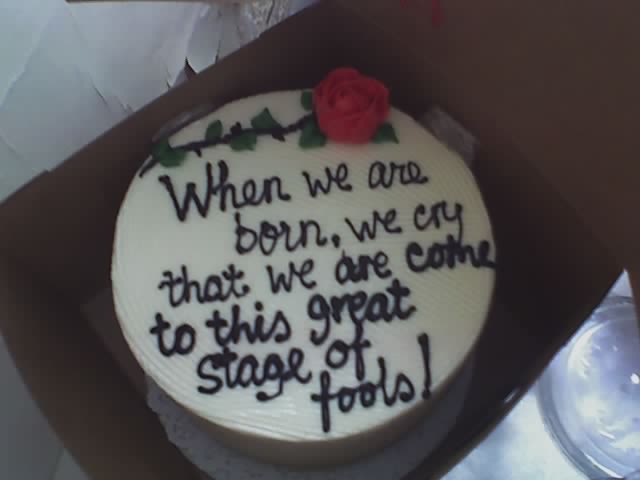
This blog just reached 10,000 hits. Huzzah! Huzzah! That’s 20,000 eyeballs! I guess it’s time to break out the cake and SiteMeter counter.

For the record, the 10,000th hit came in at 1:22pm today via a link from an English teacher’s webpage at Xavier High School, right here in New York City. The teacher is a former graduate student of mine. So here’s a big shout out to Mr. Cambras and his 9th and 10th grade students who I see are studying Romeo & Juliet, Julius Caesar, and Macbeth. (…and some other good stuff, too.) Welcome to all.

If this blog teaches you nothing else, it’s that studying great works of literature will allow you to take the letters from passages in those great works of literature, mix them around, and form new pieces of writing that kind of relate back to the original passage. And if you do that, then eventually 10,000 people will come to see them.

The End

Six Degrees of Sir Francis Bacon: Garry Kasparov

December 14th, 2007

First, read the rules of the game.

This week’s challenge is chess luminary and fellow human being Garry Kasparov.

I was able to link Garry Kasparov to Sir Francis Bacon in six degrees or fewer, though that shouldn’t stop you from posting a longer response, or looking for a shorter one. Entries will be accepted until midnight on Thursday, December 20.

Good luck!

And congratulations to Neel Mehta for winning last week’s challenge by linking Tress MacNeille to Sir Francis Bacon in four degrees:

Tress MacNeille > Lucille Ball > George Washington > Thomas Jefferson > Sir Francis Bacon

Tress MacNeille appeared in the video for “Ricky” as Lucille Ball, who is a descendent of George Washington, whose Secretary of State was Thomas Jefferson, who was heavily influenced by Sir Francis Bacon.

The End

Thursday Morning Riddle

December 13th, 2007

I’m a mother or father, but one step removed;
I am all about Benjamins, ten times improved;
I’m a fixture at concerts, not easily moved;
And a hot spot in Vegas that’s lion-approved.

Who am I?

UPDATE: Riddle solved by Ro. See comments for answer.

The End

The Headline Game – 12/12/07

December 12th, 2007

It’s been a while since we’ve had a good Headline Game.

Real life or parody? Sometimes, I can’t tell the difference anymore. That’s when it’s time for the Headline Game.

Below are two headlines from CNN.com and two headlines from Rueters News Service. Can you tell which are the real headlines and which … oh wait. They’re all real. I guess it’s not going to be much of a game this time, but feel free to discuss any of the stories behind these Onion-sounding headlines in the comments section below.

1. Deal could mean $70,000,000,000 more for war
2. President Bush vetoes child health bill again
3. Teen caller tricks White House
4. “w00t” crowned word of year by U.S. dictionary

Note: CNN headlines taken from front page of CNN.com; headline of actual story may differ.

Stories: Story 1, Story 2, Story 3, Story 4

The End

Conundrum: Solved Games

December 11th, 2007

A game is considered to be “solved” when all of the possible moves have been mapped out in a mathematical tree and thus the perfect set of moves can be determined regardless of an opponent’s play.

Tic-Tac-Toe is a pretty easy one. You solved this as a kid. There are three opening moves – corner, edge, center. And then you work from there.

Connect Four was solved in 1988. That’s because those new-fangled computer thingies were starting to get some real power behind them. If you want to play Connect Four against the best opponent you’ve ever played in your life, check out the applet on John’s Connect Four Playground which is programmed to play flawlessly, based on a database of pre-determined best moves. But if you go first, and play just as flawlessly, you can beat it.

Checkers was solved this past April by researchers from the University of Alberta. You can play against Chinook, which will play flawlessly, but the best you can hope for is a draw. It doesn’t matter how amazingly good you are at checkers. You will never win. For me, there’s something a little disturbing about that.

Could chess be next? There are an incredibly large number of possible games, but it must be finite. And if it’s finite, then the tree must conceptually exist even if nobody has been able to come close to mapping it yet. Some see chess playing ability as intutive and creative, and not merely a number cruching process. But if number crunching continues to get better, it might evolve to the point where we get a chess-playing program as unbeatable as Chinook.

To be clear, we’re not talking about a really, really good chess-playing program. We have that now. We’re talking about a program that can access an exhaustive database of pre-determined best moves in order to ensure the most favorable outcome possible.

What do you think?

Will computers ever solve chess?

The End

Question of the Week

December 10th, 2007

I was reading recently about how Shakespeare dealt with suicide differently if he was writing about Christian characters. In Christianity, suicide is always considered a sin, while in Ancient Rome, it could be considered a noble act under certain circumstances. Shakespeare, chameleon that he was, would treat the suicide based on the culture that he was writing about.

When I first read this, it rang true for me. Hamlet laments that he wishes “that the Everlasting had not fix’d / His canon ‘gainst self-slaughter!” Macbeth asks “Why should I play the Roman fool, and die/ On mine own sword?” Meanwhile, characters like Brutus and Cleopatra get heroic suicide scenes.

But the more I think about it, the less sure I am that this holds up across the canon. Off the top of my head, I can think of about four or five (arguably six) Christian characters in Shakespeare who kill themselves. There may be others as well. So I guess the Question of the Week is in two parts:

How many Shakespearean characters can you name who are Christian and commit suicide?

Do you think Shakespeare treats his non-Christian suicides differently than he treats these suicides?

The End

Shakespeare Anagram: The Merchant of Venice

December 8th, 2007

From The Merchant of Venice:

Hath not a Jew eyes? hath not a Jew hands, organs, dimensions, senses, affections, passions? fed with the same food, hurt with the same weapons, subject to the same diseases, healed by the same means, warmed and cooled by the same winter and summer, as a Christian is? If you prick us, do we not bleed? if you tickle us, do we not laugh?

Shift around the letters, and it becomes:

On these eight days, just as white snow blankets outside, we light menorahs, witness joyous children amass presents, and comment on our history and freedoms. Here, we beam feats of Judah Maccabee, who defied, and so defeated, the manacles of Seleucid antisemitism.

This website wants to wish you a Happy Hanukah season.

The End