Question of the Week
November 17th, 2008Is Obama president yet?

I am excited to announce a new (though temporary) weekly feature to the blog, inspired by the book Eunoia by Christian Bök. The book has five chapters, each using only one of the five vowels (A, E, I, O, U), and excluding the other four. I thought it might make a fun constrained writing activity for the blog.
The Challenge: I will write plot summaries for five of Shakespeare’s plays, each using a different target vowel, and excluding the other four. I will choose one play from each of the five genres. I will post one summary each Sunday for five weeks.
Five weeks. Five vowels. Five genres. Five plays.
I haven’t read Eunoia, so I don’t know how Bök deals with the letters W and Y, but I have laid down my own ground rules. Y is okay if it’s used as a consonant (as in “Yet”) or in conjunction with the target vowel (as in “boy”), but not when used by itself (as in “my”) or when it forms its own syllable (as in “every”). There will be no restrictions on the use of the letter W.
Obviously, I will need to change most of the character names to make this work. But rather than arbitrarily choosing new names, I think it would be more faithful to the constraint to choose descriptive nicknames.
For my first attempt, I have chosen to summarize a History play, King Henry IV, Part One, using “A” as the only vowel.
Enjoy!
Hal, Jack Falstaff, and a madcap charlatan band hang at a bar. Falstaff has a scam plan. Hal’s plan sandbags Falstaff. Falstaff, back at that bar, brags and brags. Hal calls Falstaff’s brag and can flash all Falstaff’s cash. Falstaff warns Hal that smart scams can’t trap Stalwart Braggart and Mad Marksman, and that Hal’s dad, Grand Man, wants a harsh chat. Falstaff playacts Grand Man and lambasts Hal. Hal playacts Grand Man and Falstaff playacts Hal. Falstaff (as Hal) says that Hal can’t cast fat Jack Falstaff away. Hal (as Grand Man) says that Hal can, and that’s a fact, Jack!
Brash Lad, Stalwart Braggart, and March all play ball, and plan an attack at Grand Man. March’s lass sang. Grand Man lambasts Hal, as Falstaff had. Hal asks vaward, and Grand Man grants that. Falstaff drafts scalawags that Hal can’t stand and flagrant dastards that pay Falstaff hard cash and walk. Mad Marksman clasps Brash Lad’s hands. Hal packs arms. Falstaff packs sack.
War starts! Mad Marksman attacks Grand Man. Hal casts Mad Marksman away. Hal and Brash Lad clash, and Hal slays Brash Lad. Mad Marksman attacks Jack Falstaff. Falstaff falls flat and playacts a carcass. Hal calls Brash Lad a gallant, and calls Falstaff fat. As Hal walks away, Falstaff plays at sarcasm and says that a gallant’s as apt as a warrant and a hangman. Falstaff nabs Brash Lad’s carcass and says that Brash Lad had drawn a last fall at Falstaff’s hand.
Hal’s man nabs Mad Marksman. Hal plays lax gallant and casts Mad Marksman away. Hal and Grand Man plan an attack at Stalwart Braggart and March. Call that play “Part B”…
From Richard III:
Hear me, you wrangling pirates, that fall out
In sharing that which you have pill’d from me!
Which of you trembles not that looks on me?
If not, that, I being queen, you bow like subjects,
Yet that, by you depos’d, you quake like rebels?
Shift around the letters, and it becomes:
Following an ugly primary, we see kooky freewheeling hubbub, mostly myth, about whether Obama may have just offered State to Hillary Clinton in Chicago on Thursday. To keep up the question, she is quoted:
“I’ll think about it.”
Via the Shakespeare Geek, we find a website that uses a Markov chain to generate an alternate version of Hamlet. Check it out!
From what I can tell, the site works from a table of which words follow other words in the play, and how often. It then constructs a chain by looking at the last word (or few words) that were entered, and choosing a random word of those that actually follow that word (or few words) in the play.
For example, one place in the play has “Alas! poor Yorick. I knew him, Horatio.” Another part of the play has “I knew your father.” The Markov chain might generate “Alas! poor Yorick. I knew…” and then, only looking at the last two words “I knew” might follow up with “your father.” The final result would be “Alas! poor Yorick. I knew your father.”
This is a favorite example provided by the author, but there are a lot of funny possibilities. You can keep refreshing the page to get a new randomly-generated Hamlet.
Thanks, Rosencrantz and Guildenstern are dead:
Ere I could accuse me of the courtier, cousin, and with a look so piteous in purport
As I perceived it, if I gall him slightly,
Whips out his rapier, cries, ‘A rat, a touch,
The queen desires you to remain
Here is your only jig-maker. What it should be old as I will be laid to us, till I know not–lost all my best obey you, and, at a shot
So art thou to me all the battlements their ordnance fire: proclaim no shame
When Roscius was an actor in Rome,–
As of a dear father murder’d,
With mirth in funeral and with a crafty madness, like the herald Mercury
New-lighted on a roar? Not one now o’er
The triumph of his own scandal.
Enjoy!
I’m the final frontier, as a few would suggest;
I loom large on the keyboard, but nothing when pressed;
I’m a Washington needle; your car’s place to rest;
And I’m traded on TV, as Paige can attest.
Who am I?
UPDATE: Riddle solved by a Glo County H.S. student. See comments for answer.
Via Electoral-Vote.com (which I’m still reading for some reason), we find another really cool map. This is an animated GIF showing the electoral results by county for every presidential election from 1960 – 2004. It’s called Purple America, and it was created by from Robert Vanderbei from Princeton University.
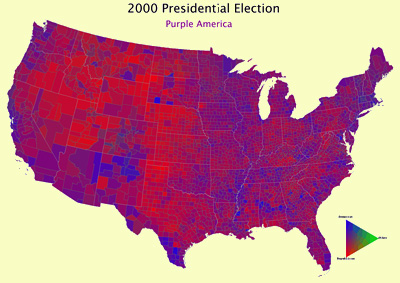
You can watch counties change from blue to red and back again. You can see where Ross Perot and George Wallace had the most support. Or you can squint your eyes and watch the entire country change its shade like a mood ring. Enjoy!
Michelle Obama’s Secret Service code name is Renaissance. Very cool.
Her husband’s codename is Renegade, and the kids are Radiance and Rosebud. More codenames can be found here and even more here.
At first, I thought it was odd that they would give all of the family members names that start with the same letter. Wouldn’t that be confusing? Not to keep dwelling on The West Wing, but Eagle and Bookbag didn’t start with the same letter. But looking over these lists, it looks like they do it with every administration. Both Bush families have code names that start with T, probably because W’s name was a holdover from his father’s administration.
It makes you think of what you’d want your Secret Service code name to be. I know what I’d want mine to be, if Michelle Obama didn’t already have it.
The First Folio (1623) delineates Shakespeare’s plays into three genres: Comedy, Tragedy, and History. More recent scholars added the category of Romance to describe some of his later plays, and there is also a fifth, more nebulous, category that goes by several different names, which describes plays like Troilus and Cressida that seem to defy genre.
How meaningful are these genres? Certainly, a play like King Lear has a very different tenor than, say, A Midsummer Night’s Dream. It’s not just a question of mood, but even the rules are different. These are plays in different genres. But does this distinction hold up across the canon? Or does each play speak for itself? This is the Question of the Week.
How much stock should we put in Shakespearean genres?
And if you say that these genres are correct, I have a few follow-up questions. Perhaps you’d like to tackle one of these as well:
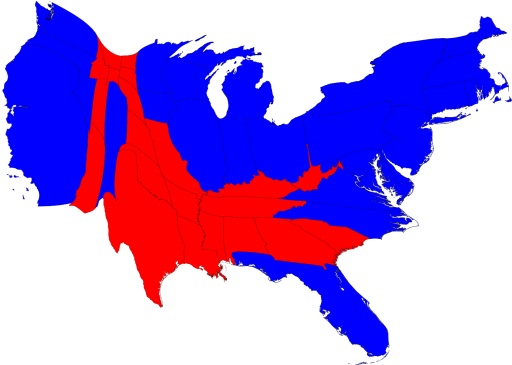
I was looking over the current electoral map, and I realized something extraordinary. If Obama took the states where he won by 7 percentage points or more, and McCain took all of the states where Obama won by 6 points or less, Obama would still have won the election 291 – 247. This would put Ohio, Florida, Indiana, and North Carolina in the red, but it would not have changed the outcome. Ohio may have locked in the Obama victory, but it turns out that he didn’t need it.
Looking at a traditional electoral map can be deceiving, because the states are shown in proportion to their land area. If instead, you look at a cartogram, you can see how the states compare to each other by, say, population (shown below) and you can really get a sense of how much of the country went red or blue. Professor Mark Newman from the University of Michigan has some good examples on his site:
From Richard III:
Enrich the time to come with smooth-fac’d peace,
With smiling plenty, and fair prosperous days!
Shift around the letters, and it becomes:
Oh, a mosaic of midnight paeans to this worthy president-elect cried mirthful pomp.
“Yes, we can!”